XRP just beat Ethereum, Solana and others in 90-Day RWA flows as traders pile back into the token


The XRP Ledger (XRPL) drew more new tokenized real-world asset capital than Ethereum, Solana, and other major blockchains over the past three months, giving XRP bulls a fresh network-growth argument as traders rebuild exposure to the token.
XRPL recorded $1.9 billion in net real-world asset inflows over the last 90 days, ahead of Ethereum’s $1.6 billion and Stellar’s $1.4 billion, according to RWA Foundation data. BNB Chain followed with $848 million, Solana with $611 million, Avalanche with $362 million, Sei Network with $202 million, and Mantle with $90 million.
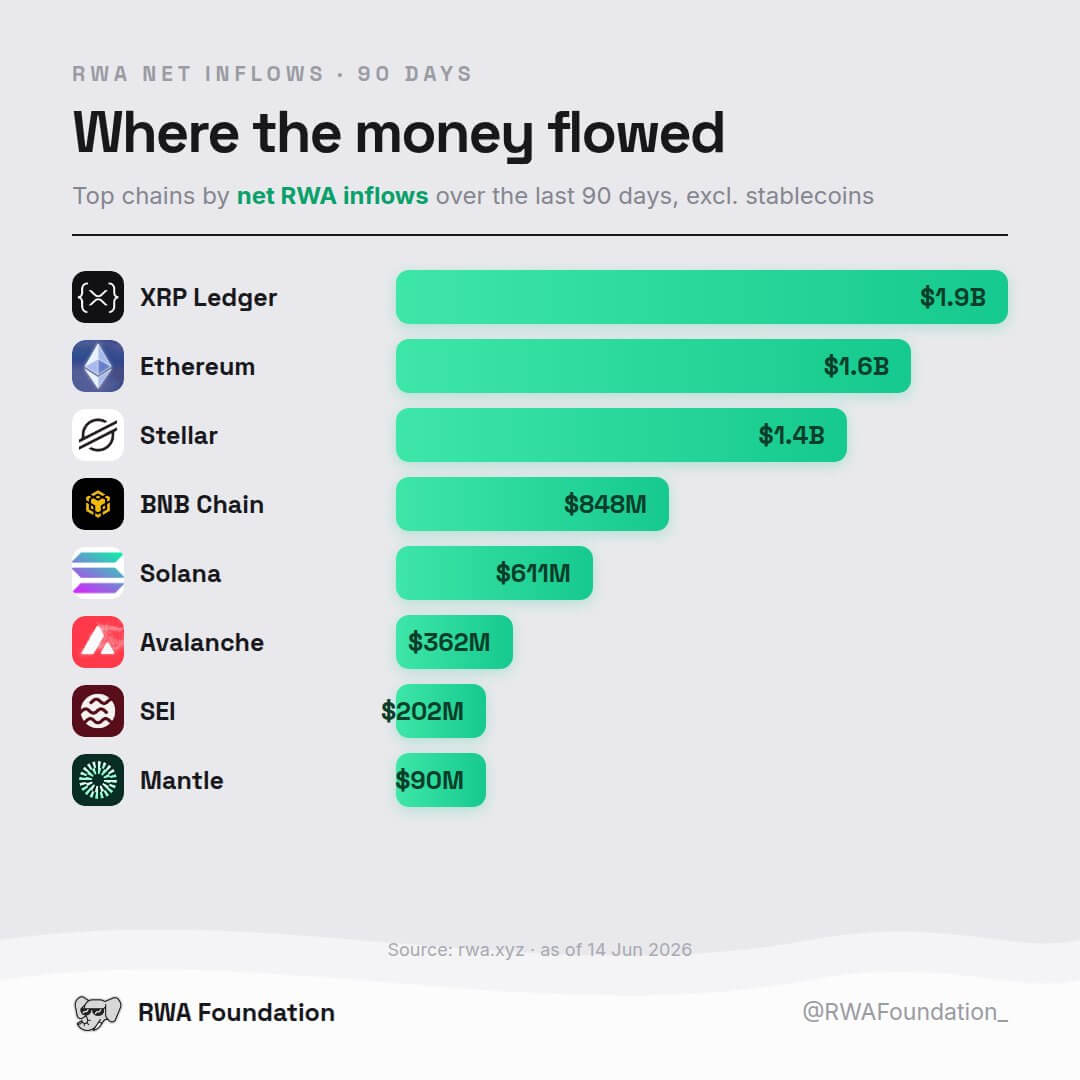
The data does not mean XRPL has displaced Ethereum as the main venue for tokenized assets. Ethereum still holds more than half of the tokenized real-world asset value tracked by RWA.xyz.
However, the 90-day flow ranking shows new capital moving more aggressively toward XRPL at a time when XRP’s derivatives and exchange-flow data are also improving.
New RWA money tests Ethereum’s lead
The acceleration of capital moving onto the XRP Ledger underscores a shifting competitive dynamic among Layer 1 networks competing for institutional issuance.
Tokenized real-world assets (RWAs), which range from digitized sovereign debt and private credit to multi-asset funds, have expanded significantly.
Data from platform RWA.xyz indicates the global market has reached $33.5 billion in distributed asset value, alongside $350 billion in broader represented asset value.
While Ethereum remains the primary venue for tokenized assets, holding a 52.8% market share with approximately $17 billion in tokenized asset value, its rate of expansion has met stiffer competition from alternative chains.
Ethereum’s asset base grew by roughly 35% over the course of 2026, a substantial rise from its baseline but a clip that is currently being outpaced by XRPL on a relative basis over the short term.
According to a recent analysis from institutional treasury firm Evernorth, XRPL’s growth trajectory sits in the top tier of established legacy networks.
Analysts at the firm noted that the deployment of institutional capital onto the XRPL is distinct due to its structural composition, especially when evaluated against peer infrastructures like Stellar, Avalanche, and Solana.
Evernoth pointed out that the XRPL network’s inflows are primarily defined by episodic, treasury-scale commitments rather than fragmented retail transactions.
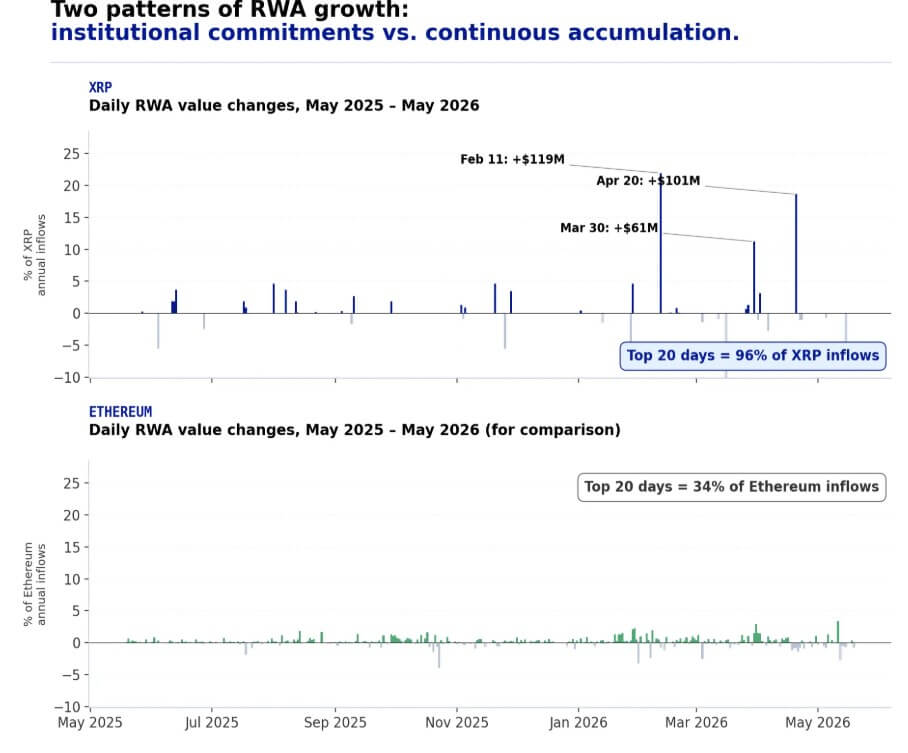
This pattern aligns with institutional deployment behavior, where large-scale financial entities execute major programmatic bond and fund originations in single tranches rather than gradual market accumulation.
XRPL’s RWA footprint
The measurement of network activity inside the real-world asset segment requires strict technical distinctions to avoid mischaracterizing on-chain liquidity.
On the XRPL, data from RWA.xyz splits the network’s footprint into two specific accounting layers: distributed asset value and represented asset value.
Currently, the total tokenized assets represented on XRPL stand at approximately $3.6 billion. This layer captures financial assets that utilize the ledger for tracking, compliance, or structural representation.
In contrast, the network’s active distributed asset value, representing assets natively settled and circulating within decentralized protocols, sits at $360.25 million.
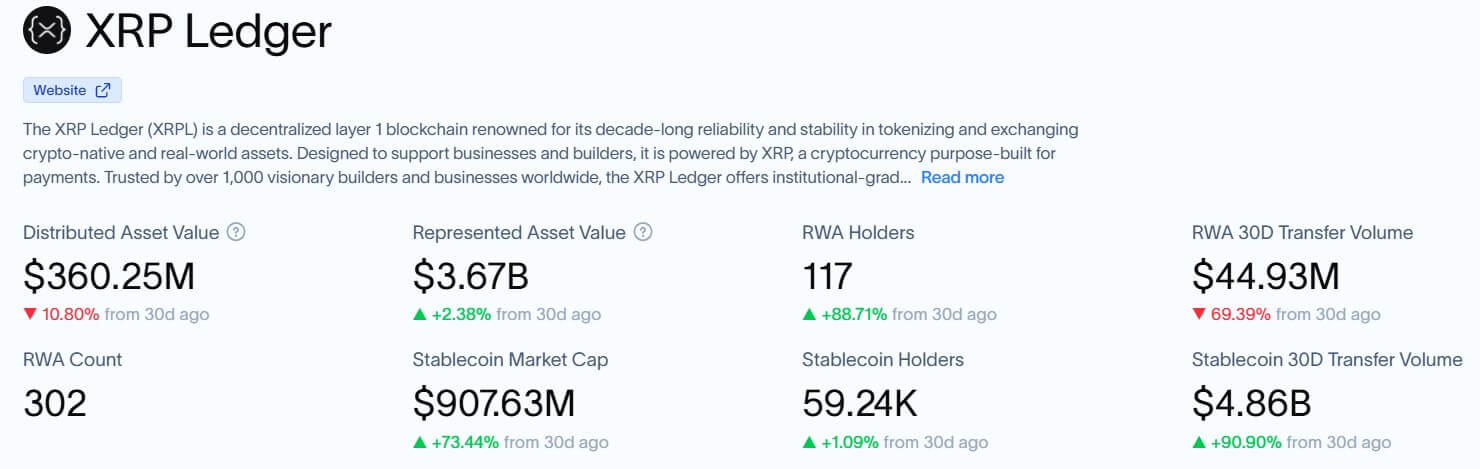
This multi-layer architecture is being utilized by commercial banking institutions and asset managers to test the structural efficiency of tokenized fixed-income securities and fund products. The operational plumbing relies heavily on underlying stablecoin liquidity to settle these transactional flows efficiently.
On-chain metrics reflect an expansion of this specific settlement infrastructure. The stablecoin market capitalization on the XRPL reached $907.63 million, marking a 73.44% increase over a rolling 30-day period.
Correspondingly, active transactional velocity has expanded, with 30-day stablecoin transfer volumes rising 90.90% to settle at $4.86 billion.
Ripple has continued adjusting its infrastructure footprint to absorb this institutional activity, advancing payment rails via corporate integrations and ramping up operational settlement mechanics linked to its RLUSD stablecoin.
Upbit becomes the center of XRP trading
The fundamental momentum across the XRPL coincides with a pronounced, though fragmented, return of liquidity to the underlying XRP cryptocurrency.
Data from Crypto Finders/em> shows that the token increased by more than 5% over the past 24-hours, testing intraday highs of $1.29 before moderating to trade around $1.24.
The price increase occurred against a broader ascending crypto market that has been fuelled by the peace deal between the US and Iran.
However, granular wallet analysis reveals that the capital flows underpinning this market structure are unevenly distributed across international trading hubs.
According to blockchain data published by CryptoQuant, wallet-flow dominance has experienced a sharp geographic rotation rather than uniform global buying pressure.
Data tracking net wallet flows shows that deposit and withdrawal activity has concentrated heavily inside South Korea via Upbit, the nation’s largest digital asset exchange. Upbit’s share of global XRP wallet-flow dominance climbed from 13% on June 7 to 31% by June 14, representing its highest concentration of network interaction since May 2024.
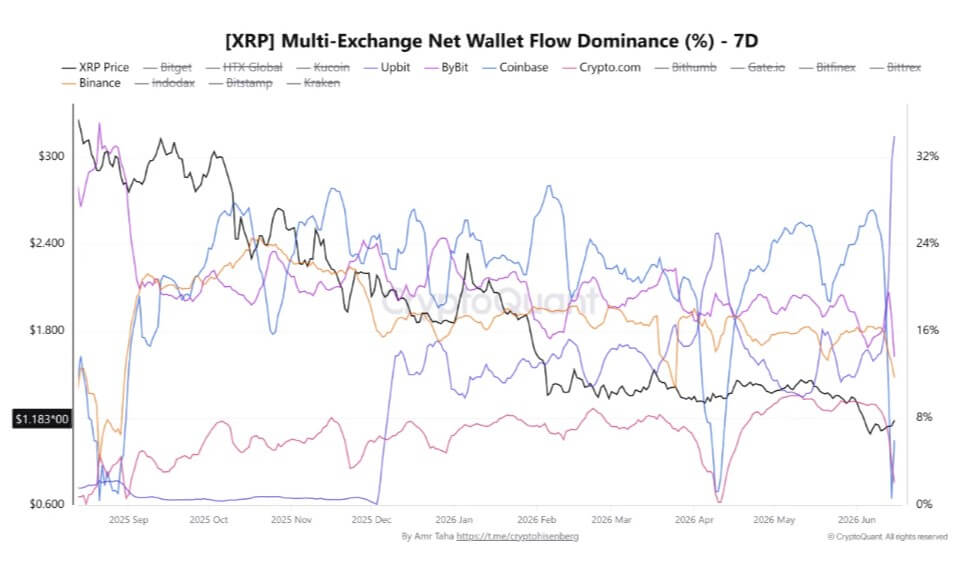
This localized acceleration stands in stark contrast to Western platforms, which have experienced a simultaneous decline in dominance.
Coinbase’s wallet-flow dominance fell from 27% on May 7 to 0% by June 14, indicating a near-total normalization or cessation of net deposit activity relative to global volumes. Over the identical timeframe, Binance’s dominance slid from 16% to 13%, and Crypto.com observed a contraction from 9% to 3%.
This internal divergence shows that the ongoing market participation is structurally divided, driven primarily by intensive capital rotation within East Asian trading venues rather than a broader retail resurgence across US or European platforms.
Derivatives markets rebound without excess leverage
The spot market shifts are mirrored within the cryptocurrency derivatives complex, where open interest metrics indicate a disciplined rebuilding of risk positions.
On Binance, which serves as the primary clearing venue for digital asset futures, the 30-day rolling average for XRP open interest climbed to its highest level in more than four months.
CryptoQuant stated that the total open interest within the contract reached approximately 486.8 million XRP, with the 30-day moving average stabilizing at 484.8 million XRP.
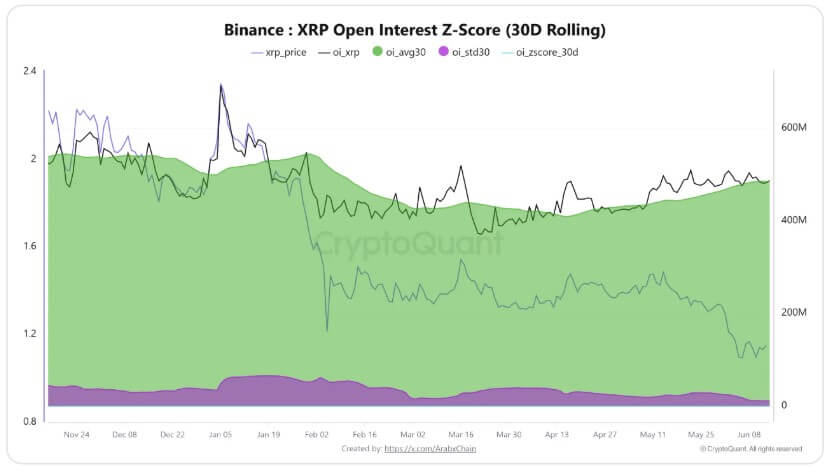
The steady upward arc follows an extended multi-month correction that purged built-up leverage from the system, pointing to a methodical return of positioning rather than speculative spikes.
Further analysis of this positioning suggests the current market structure remains balanced, with the XRP Open Interest Z-Score registered at 0.19.
By remaining firmly within normal historical boundaries, the indicator suggests that the expansion in open interest is the byproduct of a gradual accumulation of directional and hedging positions rather than unhedged leverage.
This measured build-up suggests market participants are positioning for structural volatility rather than immediate speculative liquidations.
The post XRP just beat Ethereum, Solana and others in 90-Day RWA flows as traders pile back into the token appeared first on Crypto Finders
