

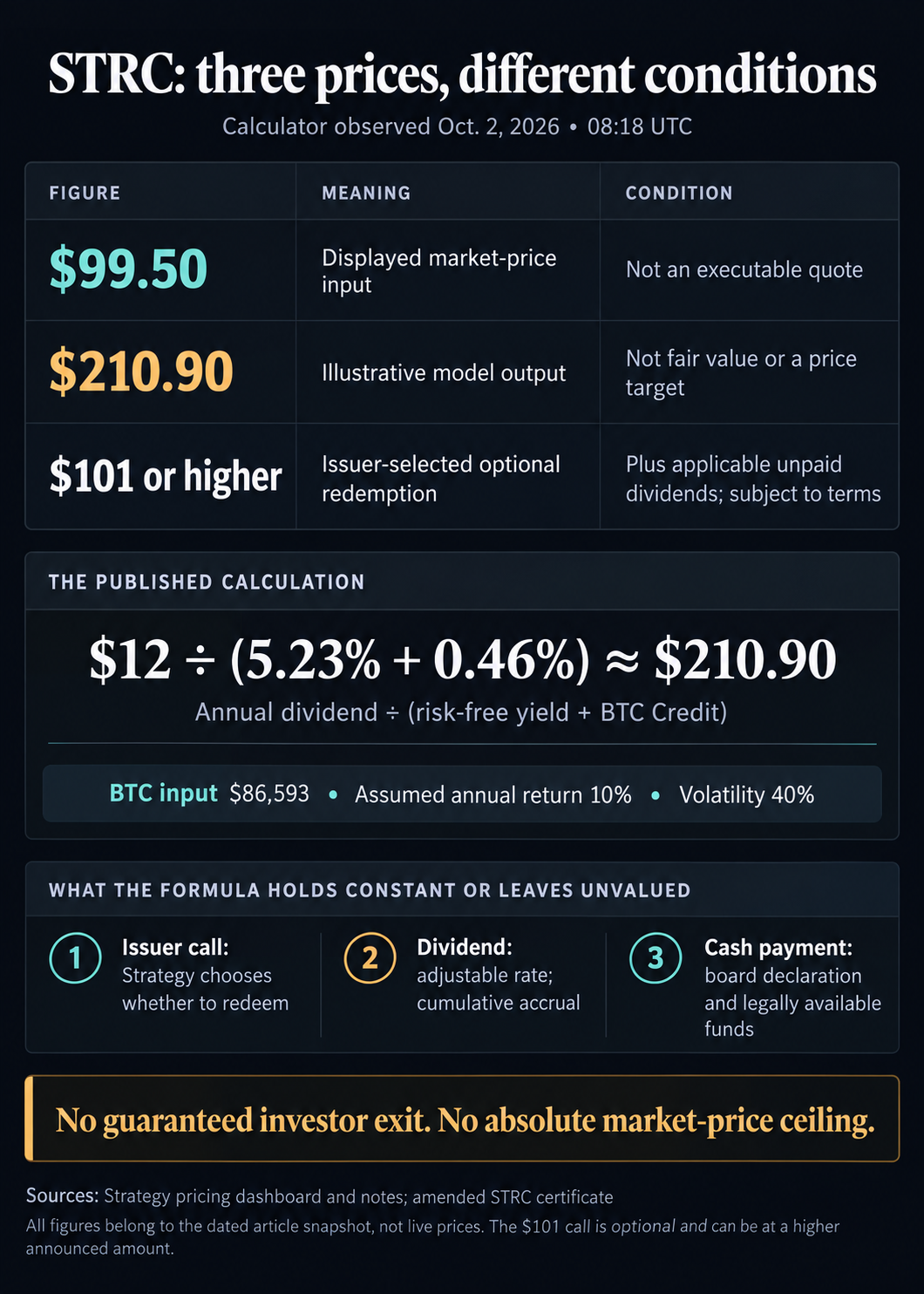
Strategy’s Bitcoin credit calculator produced an illustrative STRC price of $210.90 on Oct. 2, while displaying a market-price input of $99.50 for the perpetual preferred stock. The issuer also retains the option to redeem shares at $101, or a higher amount it chooses, plus applicable unpaid dividends.
That gap exposes the limits of the calculation. The published formula holds the current dividend constant and replaces the market’s credit spread with a modeled Bitcoin spread. It contains no explicit valuation of the issuer’s call option or a path for future dividend resets. Strategy’s pricing dashboard separately discloses those features and warns that the call can make Derived Price diverge substantially from realizable market prices.
For buyers, the calculation is a view of the security under selected assumptions. It does not establish that STRC is worth more than twice its displayed market price, or that a holder can collect either the model output or the redemption amount on demand.
How the calculator reaches $210.90
At approximately 08:18 UTC on Oct. 2, the dashboard used a Bitcoin price input of $86,593, an assumed annual return of 10% and volatility of 40%. Its STRC row showed a 12.06% effective yield, a 5.23% risk-free yield and 46 basis points of BTC Credit, Strategy’s modeled credit spread.
The published pricing formula divides the annual dividend by the sum of the risk-free yield and BTC Credit. Using a $12 annual dividend and the displayed inputs gives:
$12 ÷ (5.23% + 0.46%) ≈ $210.90.
The arithmetic reproduces the rounded output. The row’s market spread, the extra yield above the risk-free rate represented by the displayed market price, was 684 basis points. BTC Credit is the model’s estimate of that credit spread. Substituting 46 basis points for the much larger market spread lowers the formula’s discount rate and raises its output. Rounded yield inputs need not reproduce the displayed market spread exactly.
The formula makes the economic mechanism visible. Holding other inputs constant, a larger dividend raises the numerator, while a smaller modeled spread lowers the denominator. Keeping a high current dividend and using a much smaller spread can produce a large illustrative price without any change to the rights holders actually own.
Strategy expressly says the output is neither a fair-value determination nor a price target. Its assumptions include full scheduled payments and a simplified treatment of Bitcoin coverage and claims. The dashboard also warns that displayed market prices can be stale and are not executable quotes. The numbers are a dated snapshot, with Bitcoin-linked model inputs capable of changing after observation.
The output therefore cannot identify why the market price differs from the calculation. Issuer options, payment risk, trading conditions and the model’s assumptions all affect the comparison; the entire gap cannot be assigned to the call right.
Under STRC’s amended certificate of designations, Strategy can elect optional redemption at $101 per share or a higher amount it announces. Applicable accumulated unpaid dividends and compounding are added, with adjustments for declared dividends payable separately to record holders.
A partial optional redemption must leave at least $250 million of stated amount outstanding and uncalled when notice is provided. The redemption date follows the notice by between three business days and 60 calendar days. These terms govern an issuer action, rather than an ordinary holder right to cash out.
If Strategy exercises the option, the holder receives the contractual redemption payment instead of continuing to own the dividend-paying share. That possibility matters when reading a calculation that capitalizes the current dividend without explicitly valuing a call.
But the $101 figure neither promises a redemption nor imposes an absolute secondary-market price ceiling. Strategy can choose not to call, and the certificate permits a higher announced amount. A buyer also cannot assume the company will redeem merely because STRC trades below that level.
The three prices describe different things: $99.50 is the dashboard’s market input, $210.90 is an assumption-driven output, and $101 plus applicable dividends is a potential issuer-selected redemption payment. Each comes with different conditions.
The numerator is adjustable too. STRC’s current rate does not promise the same cash income indefinitely.
For each monthly reference period, ordinary rate reductions are constrained by a 25-basis-point allowance plus specified declines in one-month term SOFR, a SOFR floor and conditions covering prior accumulated dividends. Those dividends must be paid, or fully declared with sufficient consideration set aside. The restrictions limit discretion; they do not remove it.
STRC dividends accumulate cumulatively. Cash payment still requires board declaration and legally available funds. An accumulated entitlement and cash received on a particular date are different considerations for someone relying on the income.
The payment calendar has already changed from the monthly schedule described in the July 2025 offering announcement. The amended certificate effective June 30, 2026, established twice-monthly payments, while retaining monthly reference periods for rate resets.
Strategy’s Oct. 1 filing reports that its Sept. 30 action maintained the 12% annual rate for periods beginning Oct. 16 and declared a $0.50 payment for the semi-monthly period ending Oct. 31.
The daily-dividend proposal awaits an Oct. 28 shareholder vote. If approved and adopted on time, with dividends declared by the board, the planned first daily record date is Nov. 1 and first payment Nov. 2. Payments would follow record dates on the next business day.
More frequent payments would change when income arrives. They would not create a daily redemption right, lock in the dividend rate or guarantee principal stability.
Bitcoin coverage does not replace dollar capacity
Strategy’s Bitcoin holdings and its cash-payment resources answer separate questions. Bitcoin coverage concerns assets relative to claims under the model’s assumptions. Dividends payable in dollars require dollar capacity when payment comes due.
In its Sept. 28 reserve update, Strategy reported a $5.02 billion USD Reserve and a separate $1.00 billion USD Cash balance as of Sept. 27. The reserve supports preferred dividends and debt interest; USD Cash serves broader treasury and capital-allocation purposes.
During Sept. 21–27, the company used $22.1 million of the reserve for preferred dividends and $48.1 million of USD Cash to help fund STRC repurchases. Those are dated balances and uses, rather than a guarantee of future payment coverage. The broader cash pool should not be treated as interchangeable with the designated reserve.
Claim priority also matters. Debt and STRF sit above STRC, while STRK, STRE and STRD are junior preferred claims. Bitcoin is not pledged directly to STRC holders, and additional senior claims or other liabilities can affect the assets available to them.
Michael Saylor’s Sept. 29 explanation of digital credit describes Bitcoin capital and dollar liquidity as distinct parts of the structure. He presents reserve management, financing and discretionary repurchases as tools, while stating that repurchases do not guarantee a price floor. Those are management choices and objectives, rather than assurances embedded in the calculator.
Earlier Crypto Finderscoverage examined third-party dividend-durability modeling and Strategy’s buyback allocation. The issuer’s own price formula adds a narrower question: how much can buyers learn from replacing one spread while holding other inputs constant?
The answer is bounded by what the formula includes. Changes in the declared rate alter the income being capitalized; a call changes how long a holder owns that income stream; reserve decisions and senior claims affect payment capacity. At the Oct. 2 snapshot, the calculator’s large gap to the displayed market price resolved none of those contractual and payment questions.
The post Why Strategy’s STRC calculator shows $210 for a share it can redeem at $101 appeared first on Crypto Finders
