Uniswap trading volume explodes to record levels over 7 million per day – but actual fees lag far behind

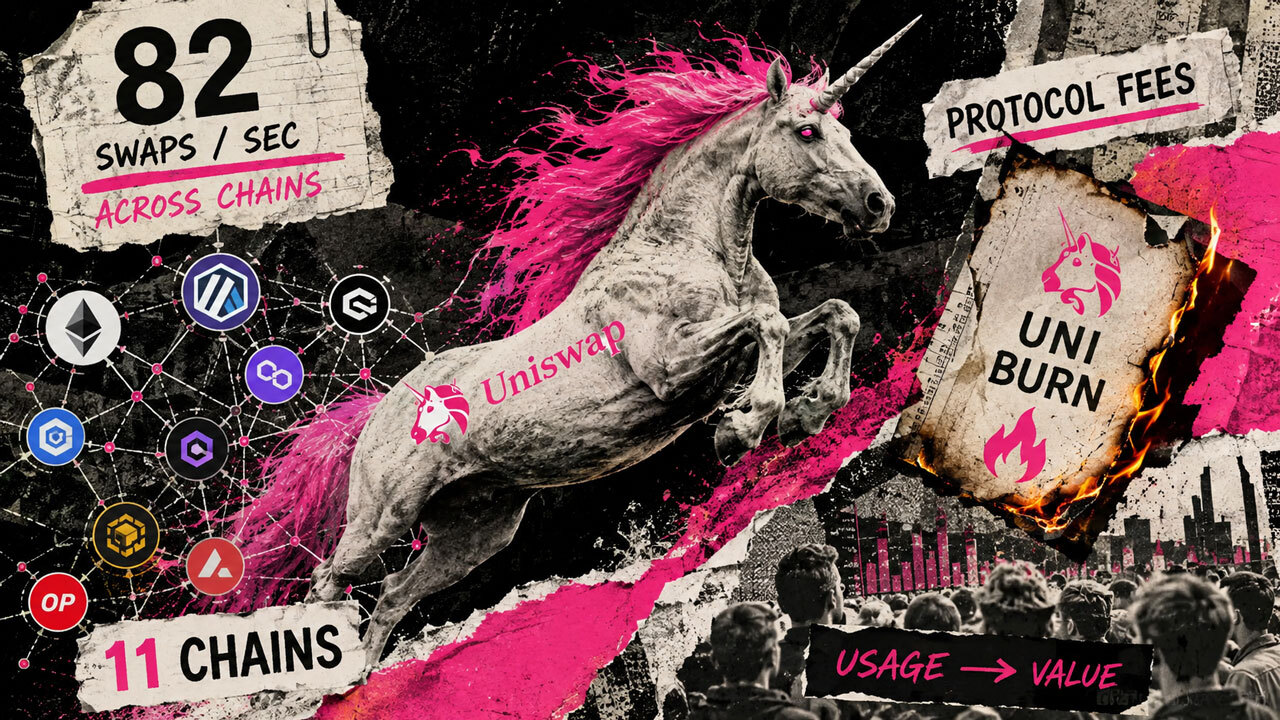
Uniswap’s new swap record is testing whether the protocol’s wider fee footprint can turn rising activity into measurable UNI burns.
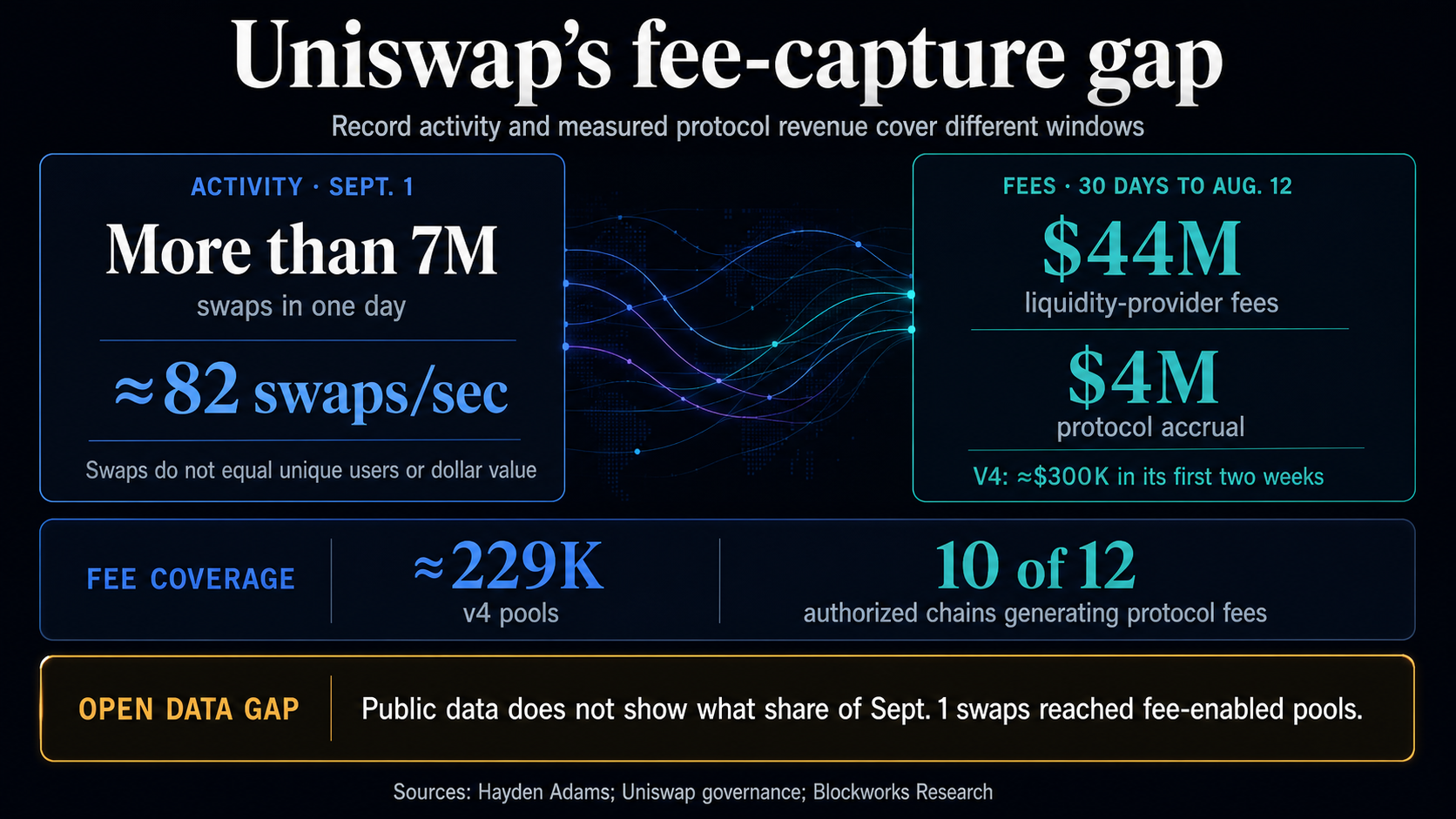
Uniswap founder Hayden Adams said Tuesday that the decentralized exchange was handling roughly 82 swaps per second across chains. He was responding to Blockworks Research analyst Marc Arjoon, who said Uniswap had recorded more than 7 million swaps in one day and its two busiest days by swap count.
Seven million swaps over 24 hours works out to at least 81 per second, making Adams’ rounded rate consistent with the reported daily total. The metric counts swaps, however, not unique users or the dollar value traded.
The milestone follows a rapid expansion of protocol fees. A July 7 governance discussion said fees were live across all v2 and v3 pools on 11 chains. On July 27, governance separately added Robinhood Chain for v2 and v3.
Governance also executed the first part of the v4 fee proposal that day, activating fee controllers on Ethereum, Arbitrum, Base, BNB Chain, Polygon, Optimism and Robinhood Chain. Five other chains were deferred to a later proposal.
Blockworks reported Aug. 12 that v4 fees had been activated across roughly 229,000 v4 pools, 10 of 12 authorized chains were generating protocol fees and nearly all pools across Uniswap versions contributed some portion of swap fees to the UNI burn.
Broad coverage does not establish that most of the record day’s swaps occurred in fee-enabled pools or show how much protocol revenue they generated. Available public Uniswap and Blockworks pages do not join the Sept. 1 swap count with fee status, volume and protocol fees over the same window.
What the Uniswap swap record says about protocol revenue
Blockworks’ Aug. 12 data primer measured about $44 million in fees earned by liquidity providers over 30 days and roughly $4 million accruing to the protocol. V2 and v3 produced $3.64 million of the protocol total, while v4 added about $300,000 during its first two weeks.
The $4 million figure is protocol accrual and the $44 million figure is LP fees. Neither is gross trading volume, router flow or swap count. Under Uniswap’s fee design, liquidity providers retain most v2 and v3 swap fees while the protocol receives a defined share. V4 applies a governance-controlled protocol fee separately.
In a July 18 update, Uniswap Labs said protocol fees had funded about 7.5 million UNI in burns since December, worth roughly $25.6 million at the valuation it used. It said monthly protocol fees rose from about $3.1 million in February to $5.1 million in June.
For recurring burns, fee assets accumulate in TokenJar. A third party can claim those assets by burning UNI through Firepit. That process is separate from the one-time 100 million UNI treasury burn approved through UNIfication as a retroactive estimate.
Record activity could expand Uniswap’s fee base, but the available data does not quantify how much Sept. 1 activity reached it. For now, value capture is measurable through the dollars accrued to the protocol and the UNI burned, not as a percentage of the latest swaps.
The post Uniswap trading volume explodes to record levels over 7 million per day – but actual fees lag far behind appeared first on Crypto Finders
