SpaceX hype collapses with $600 million still carrying leveraged bets before a massive share unlock


SpaceX’s record-setting market debut has completed a sharp reversal just over a month after the rocket and satellite company raised $85.7 billion in the largest initial public offering in history.
Data from Yahoo Finance shows that SPCX shares fell to a post-listing low of $132.28 Wednesday, slipping below their $135 offering price for the first time before recovering to close at $135.27. The stock has lost about 40% since reaching $225.64 during its first week of trading, cutting SpaceX’s market value from more than $2.8 trillion at its peak to roughly $1.8 trillion.
The downturn has erased hundreds of billions of dollars from founder Elon Musk’s fortune. The value of his roughly 42% SpaceX stake has fallen from about $1.2 trillion at the stock’s peak to around $760 billion, while the Bloomberg Billionaires Index valued his overall wealth at about $856 billion Thursday, down from $1.32 trillion in June.
Investors who chased the shares after their $150 opening price are sitting on about a 10% loss, while those who bought near the June peak are down about 40%. Retail investors received an unusually large allocation in the IPO, accounting for about 20% of the offering, and bought hundreds of millions of dollars more in the stock’s first days of trading.
Traders betting against SpaceX have moved in the opposite direction. Short sellers accumulated an estimated $8.7 billion in paper profits as the shares fell below their offering price, according to data from Ortex Technologies.
The losses mark a rapid turn from the excitement that followed SpaceX’s June listing, when a limited supply of publicly available shares, heavy retail participation and demand from index-tracking funds propelled the company above $2 trillion.
Yet the speculation surrounding that rally has not entirely disappeared. Hundreds of millions of dollars remain tied to SpaceX through leveraged cryptocurrency contracts, while tokenized versions of the stock continue circulating on blockchain networks.
Crypto traders retain leverage after the stock frenzy fades
The selloff has reduced activity on crypto exchanges without clearing out the large pool of SpaceX positions accumulated during the stock’s opening surge.
SpaceX-linked perpetual futures held about $615 million in open interest early Thursday, CoinGlass data showed. Traders generated roughly $1.6 billion in volume over the preceding 24 hours, down from more than $10 billion near the height of the post-IPO rally.
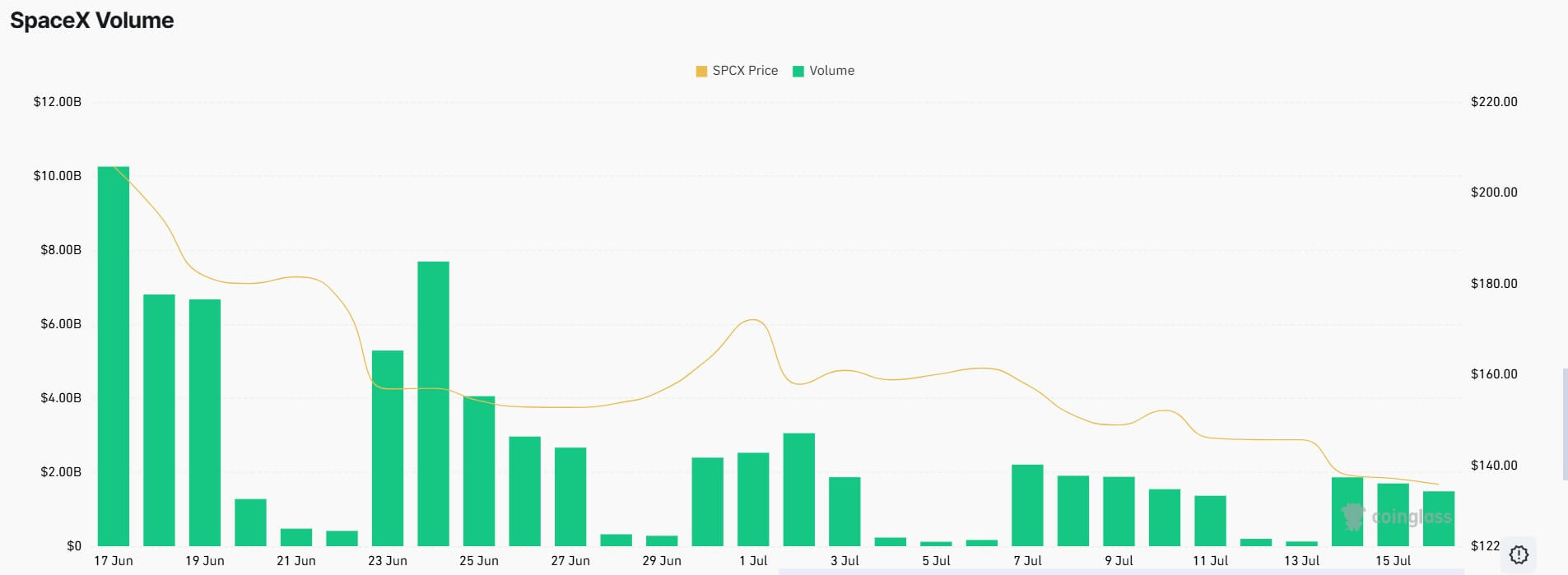
Meanwhile, SPCX Open interest has declined more gradually. Outstanding positions peaked at about $860 million in late June and have remained mostly above $600 million as the shares fell toward their listing price.
These figures show that a large amount of exposure remains even as the number of contracts changing hands has dropped by more than 80%.
Crypto exchanges introduced the perpetual contracts to allow customers to trade synthetic exposure to SpaceX around the clock. The products track movements in the Nasdaq-listed shares but do not give traders ownership in the company. They also commonly allow leverage, enabling investors to control positions worth several times the collateral they deposit.
Open interest does not indicate whether traders broadly expect a rebound or a deeper decline. Every contract has parties on opposing sides, and the total includes long positions, short positions, market-maker hedges, and arbitrage trades.
However, it does show that SpaceX’s decline has yet to force a broad retreat from the crypto derivatives market. The remaining positions could become more vulnerable to liquidations if the stock moves sharply after earnings or as more shares become eligible for sale.
Meanwhile, crypto demand has also spread beyond perpetual futures. The SpaceX xStock, a tokenized instrument designed to track the company’s shares, held nearly $25 million in assets across more than 7,800 holders, according to RWA.xyz data. The token generated about $313 million in transfer volume over the past month.
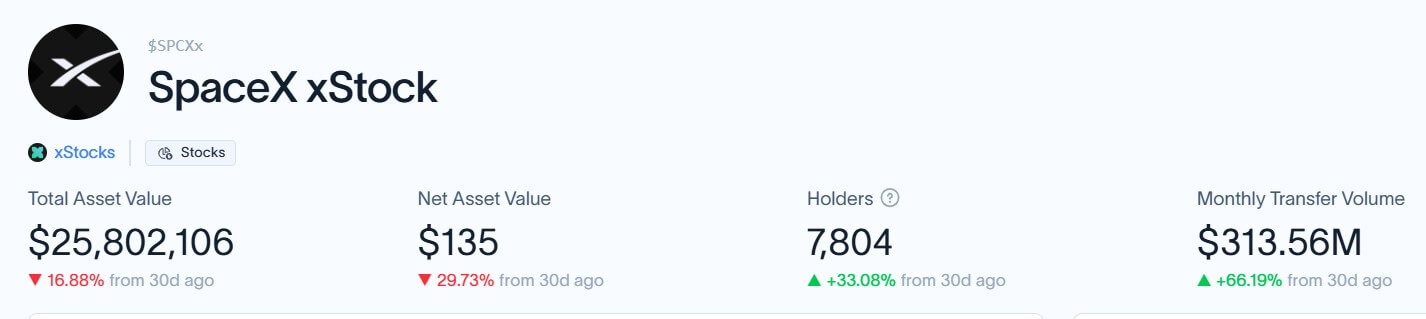
The tokenized product provides investors with exposure to SpaceX via blockchain infrastructure, though token ownership differs from directly holding the underlying Nasdaq shares. Its asset value remains small relative to SpaceX’s market capitalization, but the transfer volume shows how the IPO extended into crypto markets operating outside conventional trading hours.
Those markets amplified the initial enthusiasm around SpaceX. They could also accelerate the next move, particularly if leveraged positions are forced to close while activity remains well below its June peak.
The immediate test will come from SpaceX’s first quarterly report as a listed company and the release of a block of insider shares worth more than the stock currently available for public trading.
SpaceX’s upcoming $123 billion share unlock sharpens the divide between bulls and bears
The remaining leverage now sits ahead of a supply increase that could weaken the scarcity that helped propel SpaceX above $225.
Employees and some early investors will become eligible to sell 911.5 million shares on the second trading day after the company releases its first quarterly results, expected in early August. At Wednesday’s closing price, those shares would be worth about $123 billion, compared with roughly $86 billion of stock currently available for trading on the Nasdaq.
The release does not mean all eligible shareholders will sell. Employees may hold their stakes, early investors may gradually dispose of shares, and institutions could absorb some of the additional supply. The unlock will nonetheless give a much larger group of shareholders the ability to take profits or diversify their wealth.
Another 455.8 million shares could be released early if SpaceX closes above $175.50 in at least 5 of the 10 trading sessions leading up to the earnings report. The stock would need to rally more than 29% from Wednesday’s close to return to that level.
Meanwhile, additional restrictions will expire over the following months. By Dec. 8, as much as 40% of SpaceX could be eligible for public trading, while the remaining shares, including Musk’s stake, are expected to remain restricted until mid-2027.
The schedule supports the central argument made by SpaceX skeptics that the unusually small IPO float created a temporary imbalance between limited supply and intense demand.
In view of this, George Noble, a former Fidelity fund manager, estimates SpaceX is worth about $30 a share. He argues that the initial float of less than 5%, followed by expedited entry into major indexes, helped push the stock far above levels justified by the company’s financial performance.
Noble’s bearish case rests on the view that increasing supply of SPCX shares will expose how much of the June rally depended on scarcity. If employees and early investors sell into weaker demand, the expanded float could keep pressure on the shares even after the stock’s 40% decline.
Jamie Gull, founder of Wave Function Ventures, expects the upcoming unlock to create selling pressure as employees and investors diversify their holdings. He also argues that the larger float could generate offsetting demand because index funds will need to adjust their positions as more SpaceX shares become publicly available.
However, Gull sees the company’s launch operations and Starlink network as foundations for longer-term businesses involving Starship, lunar infrastructure and computing systems in orbit. In his view, the decline could continue toward $100 before the stock resumes a slower recovery toward $200 or higher.
Notably, most Wall Street analysts remain bullish. Twenty-seven of the 32 analysts tracked by LSEG recommend buying SpaceX, four have neutral ratings and one recommends selling. Supporters point to Starlink’s profitability, the company’s dominant position in commercial launches and the possibility that Starship could lower the cost of reaching orbit.
The earnings report will provide the first public test of those assumptions. Investors will be looking for revenue growth, spending levels, and evidence that SpaceX can fund its expansion without allowing losses and new share issuance to overwhelm its operating progress.
The post SpaceX hype collapses with $600 million still carrying leveraged bets before a massive share unlock appeared first on Crypto Finders
