
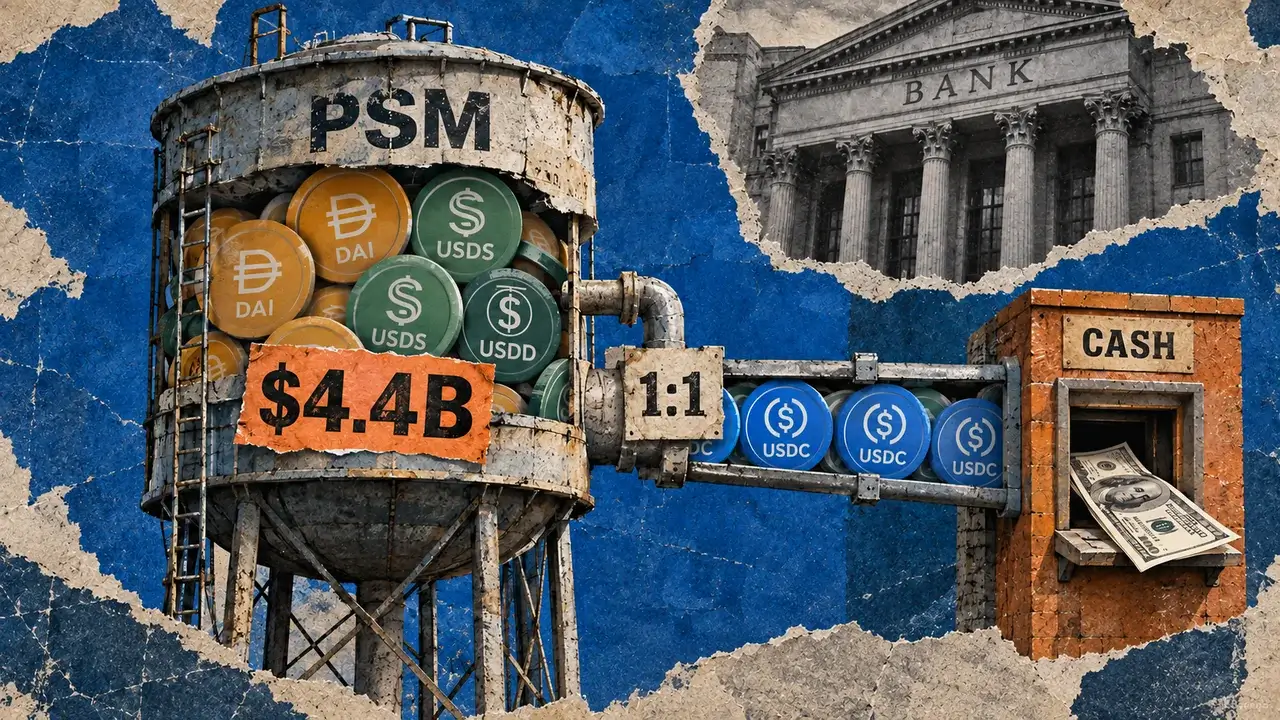
Sky.money reported more than $4.4 billion of stablecoin liquidity in its Peg Stability Module in an Oct. 9 explanation of the conversion mechanism. The PSM gives holders a direct route between USDS, Sky Protocol’s dollar-linked token, and USDC at a one-for-one rate.
Those measures answer different questions. Token circulation describes the stock of holdings. Conversion inventory describes what a holder can receive on a particular exit route. Fresh external dollar demand concerns money entering from outside the token system. Borrowing against collateral and upgrading an existing token can change individual token counts without establishing a matching inflow of bank dollars. A swap through existing inventory moves liquidity between holders or token forms; it does not by itself establish new issuance.
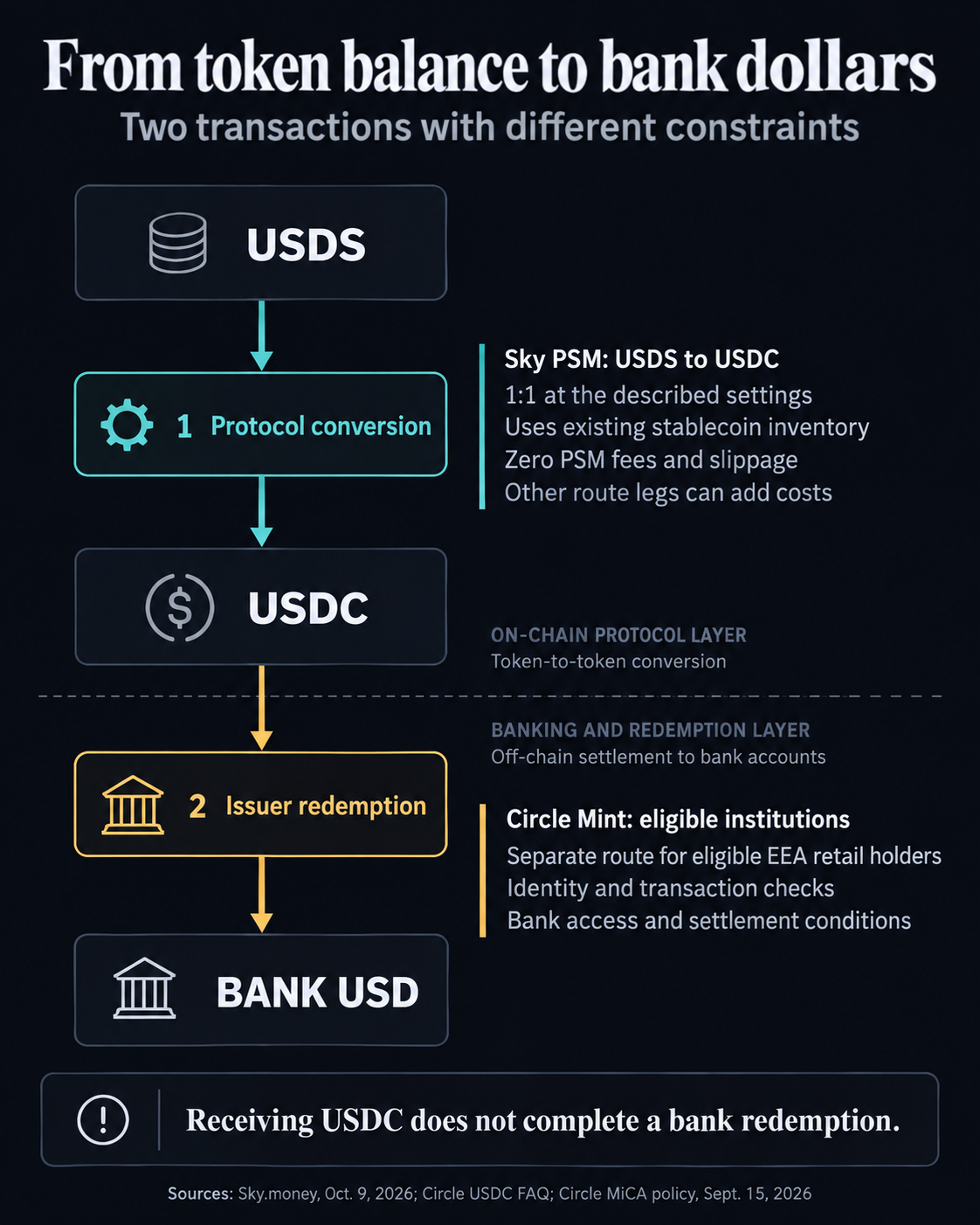
Sky describes direct USDS–USDC conversion in both directions through liquidity already held inside the protocol. The mechanism supplies the conversion itself, so it does not need to find another trader willing to take the opposite position.
At the settings described in the October explanation, the direct PSM leg has no protocol swap fee or slippage. A routed trade can still incur costs elsewhere: if it passes through another token pool before reaching USDC or USDS, that leg follows the pool’s own pricing, liquidity and fees.
The $4.4 billion figure describes aggregate stablecoin liquidity disclosed on Oct. 9. A USDS exit depends on the USDC inventory available on that route at the time of the transaction.
Sky also reported about $1.6 billion in cumulative USDC–USDS volume processed through Uniswap routing by Oct. 6, following its July 8 integration. Cumulative turnover can include movement in both directions and repeated conversions; it does not measure net USDS issuance or new dollars deposited into crypto.
Borrowing and migration change what a supply increase means
A separate Ethereum converter connects DAI and USDS. Sky’s developer documentation says the two tokens share an issuance source and that holders can convert between them in either direction without liquidity restrictions. That statement applies to the DAI–USDS converter, rather than to the availability of USDC in the PSM.
The accounting implication is straightforward: a holder can change an existing position’s denomination. An increase in USDS considered alone therefore need not represent additional money entering the wider system. Understanding the economic change requires following the DAI side of the conversion as well.
USDD is a separate collateral-backed stablecoin whose borrowing and migration routes add two more ways a token count can change. Its vault documentation describes depositing collateral, minting USDD debt and repaying the tokens plus stability fees to release collateral. Users can also withdraw collateral while maintaining sufficient coverage. This creates spendable liquidity for someone who wants to retain a collateral position, alongside an obligation to repay.
The borrower’s new ability to transact is economically useful. It can be created against assets already held, however, so each newly issued token does not require a corresponding new bank-dollar deposit. The pledged assets support the debt; their valuation is a different measure from the stablecoin inventory available to satisfy an immediate conversion request.
USDD also offers a migration route from USDDOLD into an equivalent amount of new USDD, with gas costs and no deadline. Here, a higher count in the new token can reflect an upgrade of an existing holding. Comparing old and new contracts separately can obscure whether the underlying economic position has increased.
A supply comparison needs consistent observation times and stated token coverage, including how it treats legacy tokens and holdings that back other tokens.
| Route | What the holder provides | What the transaction establishes |
|---|---|---|
| Circle Mint issuance | Bank USD through an eligible account | A direct fiat-funded issuance route |
| USDC–USDS PSM conversion | An existing stablecoin | A conversion through protocol liquidity |
| DAI–USDS conversion | An existing DAI or USDS holding | A change between linked token denominations |
| USDD vault issuance | Collateral supporting a debt position | Borrowing-created spending liquidity |
| USDDOLD migration | An existing legacy-token holding | An equivalent holding in the new token |
USDD’s PSM instructions make the immediate constraint explicit. The mechanism offers one-for-one conversion between USDD and supported stablecoins, with no service fee but network gas costs. Users must check the displayed quantity of the target token and keep their swap within that available amount.
A holder seeking USDT needs the inventory that can deliver USDT. An aggregate collateral valuation cannot substitute for that balance, just as a debt position’s backing cannot automatically be treated as an uncommitted pool of redemption cash.
Receiving USDC is a separate step from receiving bank dollars
USDC issuer Circle describes a more direct fiat connection in its USDC issuance and redemption process. Eligible businesses deposit dollars into Circle accounts to obtain newly minted USDC. Returning USDC for dollars removes the redeemed tokens from circulation. Circle says the backing consists of highly liquid cash and cash equivalents, with most reserves invested in the Circle Reserve Fund, whose portfolio can contain short-dated Treasuries, overnight Treasury repurchase agreements and cash.
A purchase on an exchange can instead draw on USDC already held by the exchange. Circle says an exchange may mint additional tokens when it needs more inventory. A buyer’s demand for USDC therefore need not trigger a new issuance transaction each time.
Access also differs between a protocol conversion and bank redemption. Circle Mint is an institutional product that is unavailable to individuals and small businesses through that service. Eligible retail holders in the European Economic Area have a separate direct route with Circle France.
Circle’s MiCA redemption policy, last updated Sept. 15, requires eligibility, identity and transaction checks, along with an EEA bank account that can accept USD for a USDC redemption. For eligible EEA retail holders, the policy gives a five-business-day timeframe unless discrepancies arise. It also permits deferrals during a stress event that prevents reserve rebalancing between Circle France and Circle LLC.
For a USDS holder seeking bank dollars, obtaining USDC through the PSM completes the token-conversion leg. The issuer and banking route still has to complete the cash leg. A stablecoin conversion balance and a bank payment are separate stages of access to dollars.
The post Sky’s $4.4 billion liquidity disclosure shows why USDS cash-outs need a separate bank route appeared first on Crypto Finders
