
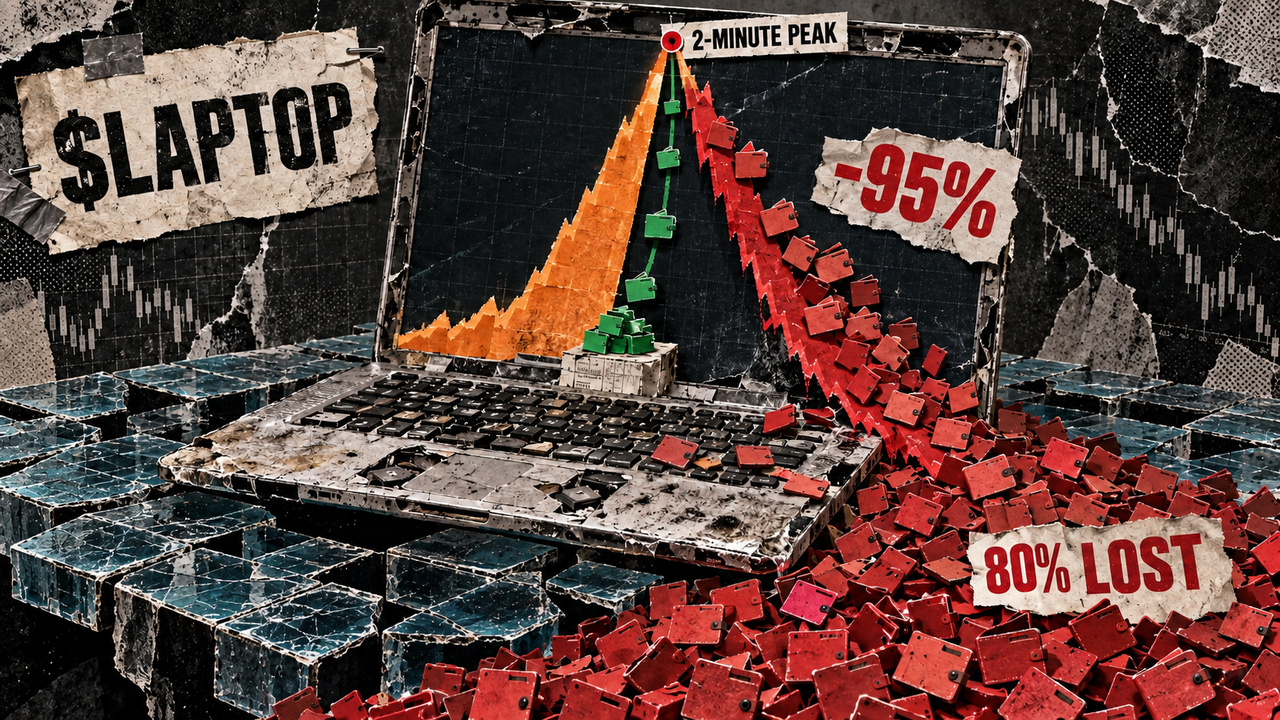
Hunter Biden’s LAPTOP token left nearly 80% of traders underwater within hours despite being pitched as an answer to memecoin grift. Hunter Biden is the son of former US President Joe Biden.
Data from Bubblemaps showed that 12,151 of the token’s 15,206 traders lost money, while only 3,026 were profitable and 29 were at break-even or held positions that could not be priced.
Most of the losses were relatively small, with 11,311 wallets down less than $1,000. But 726 traders lost between $1,000 and $10,000, another 112 lost between $10,000 and $100,000, and two were down between $100,000 and $1 million.
The other side of the trade was far more concentrated. Just 10 wallets made between $100,000 and $1 million, while another 78 earned between $10,000 and $100,000.
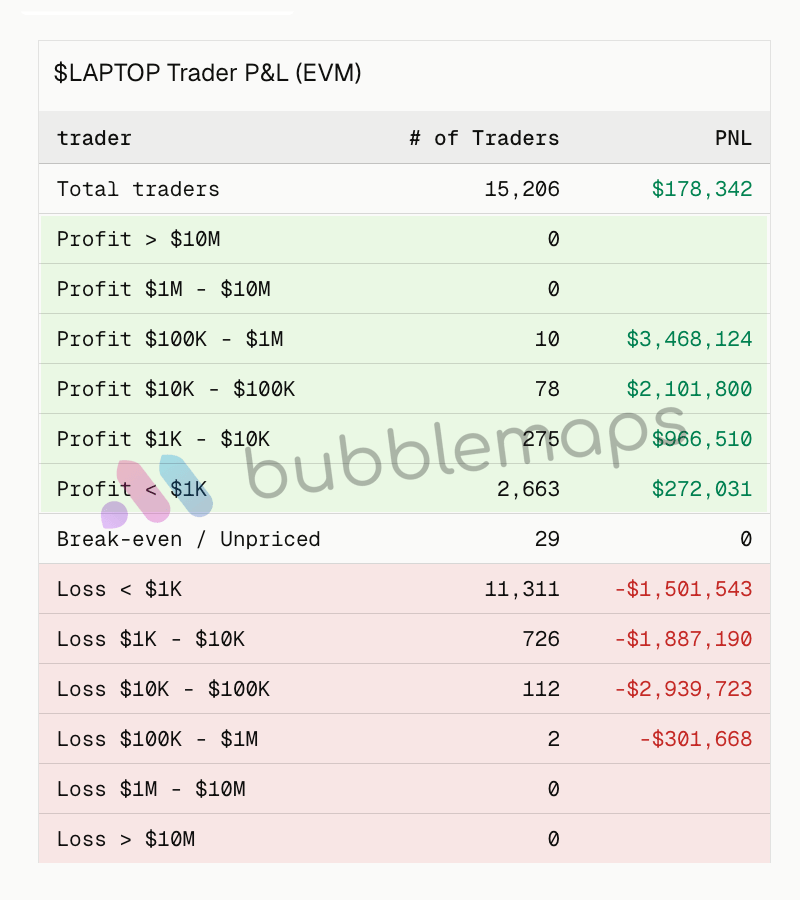
Those 88 traders collectively generated about $5.57 million in profit, helping leave aggregate trader P&L slightly positive at roughly $178,000 despite almost four out of every five participants losing money.
The outcome cuts directly against one of Biden’s main arguments for launching the token. He had criticized President Donald Trump’s TRUMP memecoin for leaving nearly 1 million wallets with what he described as about $3.8 billion in collective losses, while promising that LAPTOP would include an airdrop for some of those burned investors.
“I understand the cynicism,” Biden said before the launch, questioning why he would support an industry product that had been “misused by grifters.” He added:
“You should not expect me or anyone else to make this token more valuable for you.”
However, LAPTOP had created another sharply divided group of memecoin winners and losers within minutes.
LAPTOP’s anti-grift pitch met a two-minute peak
LAPTOP began trading on Base at about 8:02 a.m. ET and peaked roughly two minutes later, blockchain analytics firm Arkham Intelligence said.
The token’s fully diluted valuation briefly flashed about $144 billion even though the liquidity pool contained only around $48,000. The valuation did not mean investors had poured anywhere close to $144 billion into LAPTOP.
The thin liquidity meant relatively small trades could move its quoted price dramatically and produce an enormous theoretical valuation.
LAPTOP dropped more than 95% over the following half hour as the market struggled to establish a price.
Arkham later identified two principal on-chain trading pools. The official Aerodrome pool contained about $83,000 in USDC, while a Uniswap pool held roughly $380,000.
The latter liquidity appeared to have been deployed in a range that did not become active until LAPTOP had already fallen about 90% from its opening surge.
That structure created dramatically different outcomes depending on when traders entered the market.
Blockchain analysis firm Lookonchain identified one trader who spent just 900 USDC to acquire 2,268.56 LAPTOP at about 40 cents each, then rapidly sold the position for 251,270 USDC at an average price near $111. The trade generated more than $250,000 in profit, roughly a 278-fold return.
Another wallet spent 100 ETH, then worth about $249,800, to buy 9,124 LAPTOP before selling 8,480 tokens for 472 ETH, worth about $1.18 million. The address still held 644 LAPTOP when Lookonchain reviewed the trade, taking its realized and unrealized gains above $1 million at the time.
For traders arriving seconds or minutes later, the economics were reversed.
One wallet withdrew $250,000 from Binance before the launch and spent $200,000 buying 919 LAPTOP at an average price around $218. Lookonchain later valued the position at roughly $3,000, an unrealized loss of about $197,000.
Fresh wallets add another question to LAPTOP’s launch
Bubblemaps found an unusual feature among LAPTOP’s largest holders: roughly 60% were “fresh wallets,” addresses funded within the previous 10 days that showed no earlier activity.
Most were funded on the day LAPTOP launched.
That does not, by itself, show the wallets were coordinated, controlled by insiders, or had advance information. Newly created addresses are common around token launches, particularly when traders separate activity across wallets.
However, the concentration adds scrutiny to a launch in which getting into the market even minutes earlier produced radically different financial outcomes.
It also complicates Biden’s attempt to distinguish LAPTOP from the political memecoins he criticized.
The project has a fixed supply of 1 billion tokens. Its website shows 20% allocated across two community airdrops, although the first distribution gives only 2% of the total supply to wallets that lost money trading TRUMP. Another 30% goes to founders, including Biden, with those tokens locked for six months and vesting over two years.
An additional 30% is tied to 30 predetermined political, crypto, and cultural outcomes. Tokens associated with predictions that come true are permanently burned, while those attached to failed predictions are earmarked for charity. Another 5% of supply is allocated directly to charity.
Biden also explicitly warned buyers before trading began that neither he nor anyone else should be expected to increase the token’s value. He framed ownership as an expression rather than an investment and said the project was intended to reclaim the laptop episode that dominated years of coverage of him.
Biden wrote:
“They turned laptop into a weapon. I turned it into a token.”
That token now faces a different test. The founders’ allocation remains locked, removing an immediate source of insider selling, but LAPTOP must build substantially deeper liquidity to avoid the extreme price dislocations that defined its first hours.
The post Hunter Biden launched LAPTOP to cure memecoin grift and created a whole new batch of losers appeared first on Crypto Finders
