

TLDR
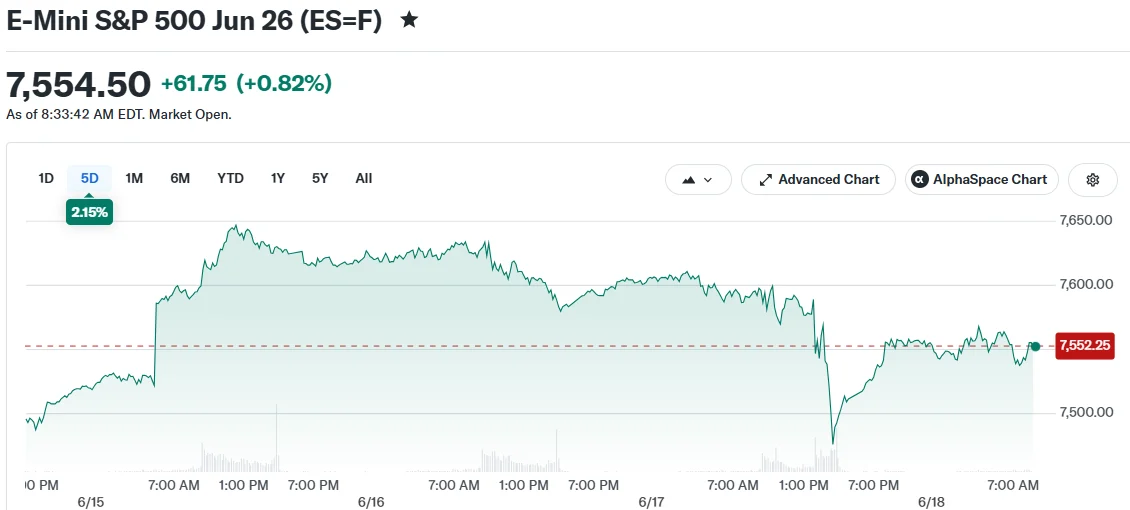
Stock futures advanced Thursday morning, with Nasdaq 100 futures gaining 1.3% while S&P 500 futures rose 0.7%
Trump signed a peace framework with Iran on Wednesday, ahead of the anticipated Friday timeline
The agreement could facilitate reopening of the Strait of Hormuz, potentially reducing crude oil prices
Brent crude tumbled approximately 3% following the announcement, dipping under $78 per barrel before rebounding slightly
Federal Reserve maintained current rates Wednesday while indicating a potential increase later this year, with October widely anticipated
Equity futures advanced Thursday morning as market participants digested two significant catalysts: an early signing of a peace framework between the United States and Iran, alongside the Federal Reserve’s latest commentary on monetary policy.
Nasdaq 100 futures paced the advance with a 1.3% gain. S&P 500 futures climbed 0.7%, while Dow Jones futures posted a modest 0.2% increase. This followed widespread declines across all three benchmark indexes during Wednesday’s session.
Early Signing of Iran Peace Framework
President Trump executed a memorandum of understanding with Iranian officials Wednesday, catching markets off guard with timing ahead of the widely expected Friday announcement. The comprehensive 14-point document establishes a roadmap for normalized relations between both nations.
The agreement has generated optimism regarding the potential reopening of the Strait of Hormuz for international commercial vessels. Such a development would enable increased Iranian crude oil exports to global markets, creating downward pressure on energy costs.
Brent crude futures experienced a sharp decline of up to 3% in response, sliding beneath the $78 per barrel threshold. West Texas Intermediate decreased roughly 2% to approximately $74.57. Both benchmarks subsequently recouped portions of their losses amid lingering questions about initial maritime passage through the strait.
Ongoing discussions regarding Iran’s nuclear capabilities and additional strategic matters are scheduled to unfold during the next 60-day period.
Federal Reserve Indicates Potential Rate Adjustment
The Federal Reserve maintained its current interest rate policy during Wednesday’s meeting, though Chairman Kevin Warsh communicated that the central bank may implement a rate increase before year-end. Persistent inflation pressures and robust employment conditions have influenced this outlook.
According to Deutsche Bank economist Peter Sidorov, financial markets are now completely pricing in a Federal Reserve rate hike by October.
This hawkish messaging from the Fed contributed to substantial equity declines Wednesday, with the Dow plummeting over 500 points. However, the Iran peace development helped counterbalance those concerns during overnight trading, propelling futures higher ahead of Thursday’s market opening.
The 10-year Treasury note yield declined 5 basis points to 4.45%. The US dollar index strengthened 0.3% relative to major global currencies.
Bitcoin declined 1.7% during the previous 24-hour period to approximately $64,347. The cryptocurrency’s retreat reflected diminished risk appetite following the Federal Reserve’s more aggressive stance.
Weekly unemployment claims figures were scheduled for release Thursday, providing market participants with additional labor market insights.
US equity markets will remain closed Friday for the Juneteenth federal holiday, making Thursday the final trading session of the week.
Japan’s Nikkei index achieved a historic milestone by closing above 70,000 for the first time, contributing to positive global market sentiment entering the US trading day.
