

Bitcoin’s estimated US mining footprint shrank as Russia’s grew, with little change in top-three country concentration.
Hashrate Index’s Oct. 5 country estimates put the US at about 335 EH/s, down from 345 EH/s in the previous edition, while Russia rose from 162 to 170 EH/s.
The US, Russia and China still account for roughly 66% of the estimated network. Their combined share slipped by about 0.8%, even as the global hashrate estimate stayed almost flat.
That is a modest change in geographic concentration, with a clearer shift in the balance between the two largest mining locations.
Luxor Technology’s mining data platform Hashrate Index labels the report its fourth-quarter update, but the figures describe observations from the preceding third quarter. Its July 16 comparison edition described June estimates.
The October publication is neither a completed fourth-quarter result nor a live census of where machines are operating on Oct. 6.
A smaller US share leaves the same three leaders
The comparison separates absolute mining activity from network share. Estimated US hashrate declined as its share fell from 36.7% to 35.6%, while Russia gained both estimated hashrate and share, rising from 17.2% to 18.1%. China’s estimate declined from about 115 to 110 EH/s.
| Location or metric | July edition | October edition |
|---|---|---|
| United States | About 345 EH/s; 36.7% | About 335 EH/s; 35.6% |
| Russia | About 162 EH/s; 17.2% | About 170 EH/s; 18.1% |
| China | About 115 EH/s; 12.2% | About 110 EH/s; 11.7% |
| Global network | About 940 EH/s | About 941 EH/s |
The network total is a 30-day simple moving average of hashrate, the computing work devoted to mining.
The provider’s methodology summary describes a weighted combination of pool data, ASIC trading flows, and firmware adoption trends.
Cambridge’s separate mining-map methodology warns that a pool sample may be unrepresentative and that VPNs or proxies can distort inferred location.
Hashrate Index’s October comparison puts the top three countries’ combined share at 65.4%, down from 66.2%. Calculating from the rounded EH/s inputs reproduces approximately that 0.8% decline. The resulting balance leaves the US with a smaller share and Russia with a larger one, while the same three countries remain dominant.
July’s printed country shares add to 66.1%, while the rounded EH/s figures reproduce the provider’s 66.2% aggregate after rounding. These differences are distinct from sampling or estimation error, and the comparison provides no confidence range to demonstrate statistical significance.
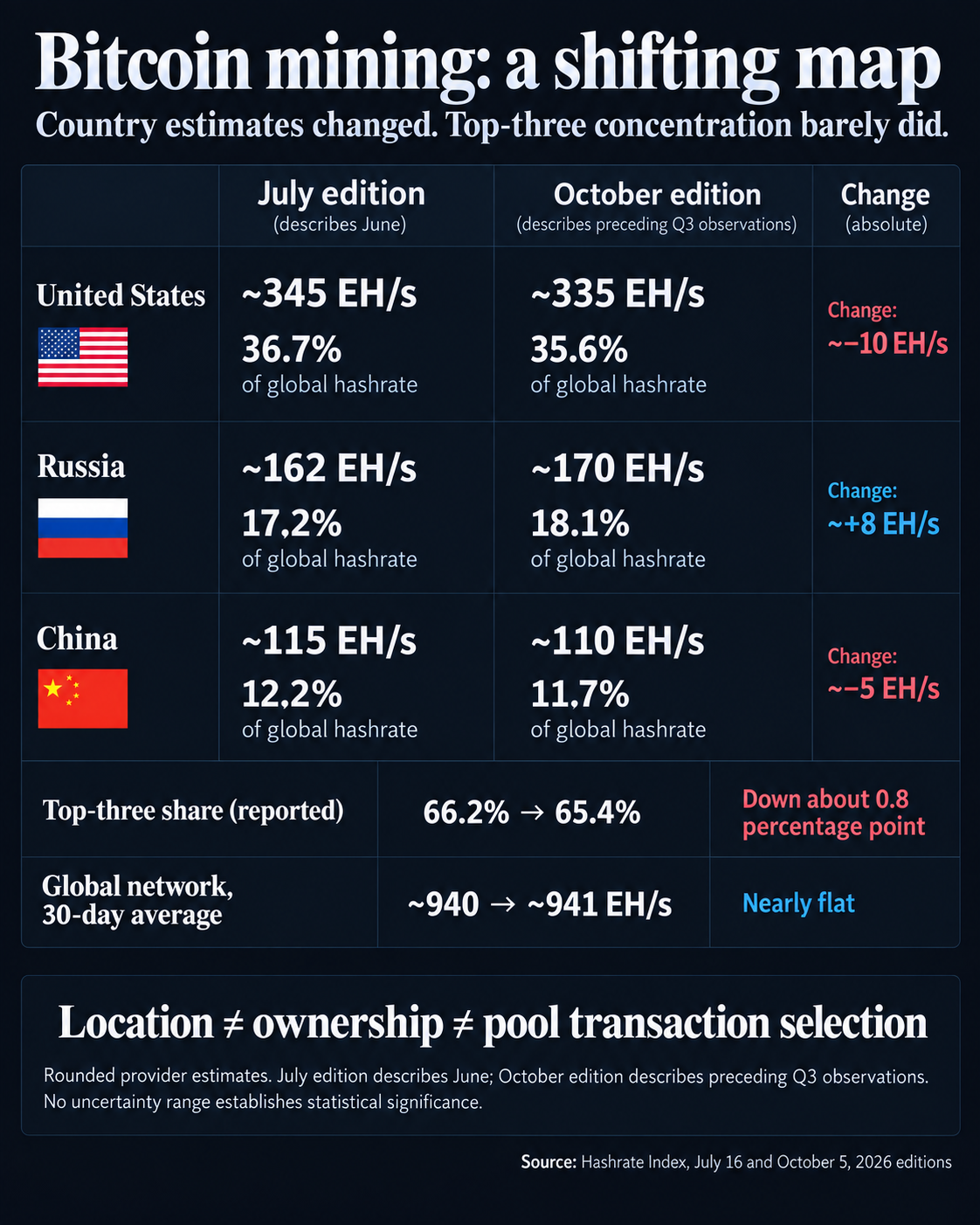
A smaller estimated US share reduces the portion attributed to that jurisdiction, while a larger Russian share increases the portion attributed to Russia. Those movements change exposure to particular locations without showing that the network has acquired many more independent sources of mining capacity.
Machines switching off in one country and other machines switching on elsewhere can change the distribution without the same equipment moving between them. The country totals do not establish a transfer from the US to Russia.
Location leaves ownership and operating status unresolved
A country’s mining share describes where computing activity is estimated to occur, and beneficial ownership asks who ultimately owns that equipment.
Pool control asks who coordinates mining work and selects the transactions proposed for blocks. Treating these as interchangeable would turn a location estimate into a claim about decision-making power.
The Bitcoin developer guide’s pooled-mining explanation separates the miners supplying hashing work from the pool that coordinates it and distributes rewards. In its legacy Stratum example, miners receive the information needed to construct block headers without being able to inspect or add transactions to the block.
That arrangement makes transaction selection independent of the machines’ physical location. Spreading hardware across more countries does not show that more independent parties choose block contents.
Equally, a pool coordinating work is not automatically the beneficial owner of all the equipment contributing to it.
Stratum V2’s transaction-selection design allows miners to choose a transaction set optionally, a capability that does not establish how widely it is used today.
A fuller assessment would need ownership information and contemporaneous evidence about pool participation and block-template selection. The quarterly country figures establish neither improved ownership diversity nor unchanged pool concentration.
Geography also leaves open what is happening at individual sites. Luxor attributes some regional mining declines to the switch toward artificial intelligence and high-performance computing. Individual company disclosures show that conversion activity is real.
In its Aug. 10 operational disclosure, Keel Infrastructure said it had completed decommissioning all its US Bitcoin mining operations in preparation for HPC construction.
Core Scientific’s July 28 results described an ongoing process of repurposing its remaining mining facilities for high-density colocation services as circumstances allow. That is a different operating status from a completed mining exit.
These examples substantiate particular companies’ actions. Reports on miners’ AI commitments examined the execution question before this country comparison appeared.
Temporarily idled equipment may resume work if the conditions that caused curtailment improve. A site being reconstructed or committed to another workload faces a different path back. A hashrate decline alone does not tell readers what happened or how durable it will be.
Luxor also describes an Ethiopian power restriction in explaining that country’s decline. Such explanations need their own evidence: a country delta cannot establish the contribution of power rationing, seasonal conditions, or policy. The geographic estimates and the proposed causes remain separate claims.
The network estimate barely changed, from about 940 to 941 EH/s. That aggregate can coexist with lower US activity because gains elsewhere offset losses, saying little about whether US miners have recovered operating capacity or improved their own economics.
The next useful evidence is specific to the mining risk being assessed: repeated country observations for persistence, company disclosures distinguishing actual conversion from curtailment, and ownership and pool data for control. A single nearly flat network total cannot answer all three.
For now, geographic exposure has shifted within a still concentrated mining network. Establishing broader decentralization gains requires evidence about who owns and coordinates the capacity, as well as where it sits.
